February 26, 2026
Every business that deals with physical products needs a proper storage system. This is where warehouses play an important role. A warehouse is not just a big storage space. It is a place where goods are stored, sorted, packed, and shipped in a planned way.
Today, businesses use different types of warehouses based on their size, industry, and supply chain needs. In logistics, choosing the right warehouse setup can directly affect delivery speed, inventory control, and overall cost.
There are also different types of warehouse management systems that help companies track stock, manage orders, and improve daily operations. Understanding the types of warehouse in logistics helps businesses make better decisions and avoid unnecessary problems. In this blog, we will understand the different types of warehouses, their functions, and how to choose the right one for your business.
A warehouse is a storage facility where goods are kept before they are sold or delivered. Businesses use warehouses to store raw materials, finished products, or bulk inventory. It acts as a link between manufacturers, suppliers, and customers.
A warehouse is not only for storage. It also handles activities like sorting, labeling, packing, and shipping. Many warehouses use technology and different types of warehouse management systems to track inventory in real time and reduce errors.
In logistics, a warehouse helps maintain the right stock level. It prevents stock shortages and also avoids overstocking. Proper warehouse management makes sure products are safe, organized, and ready for dispatch.
The role of warehouses has grown in recent years due to eCommerce and faster delivery demands. Companies now focus on choosing the right types of warehouses to match their business model and customer expectations.
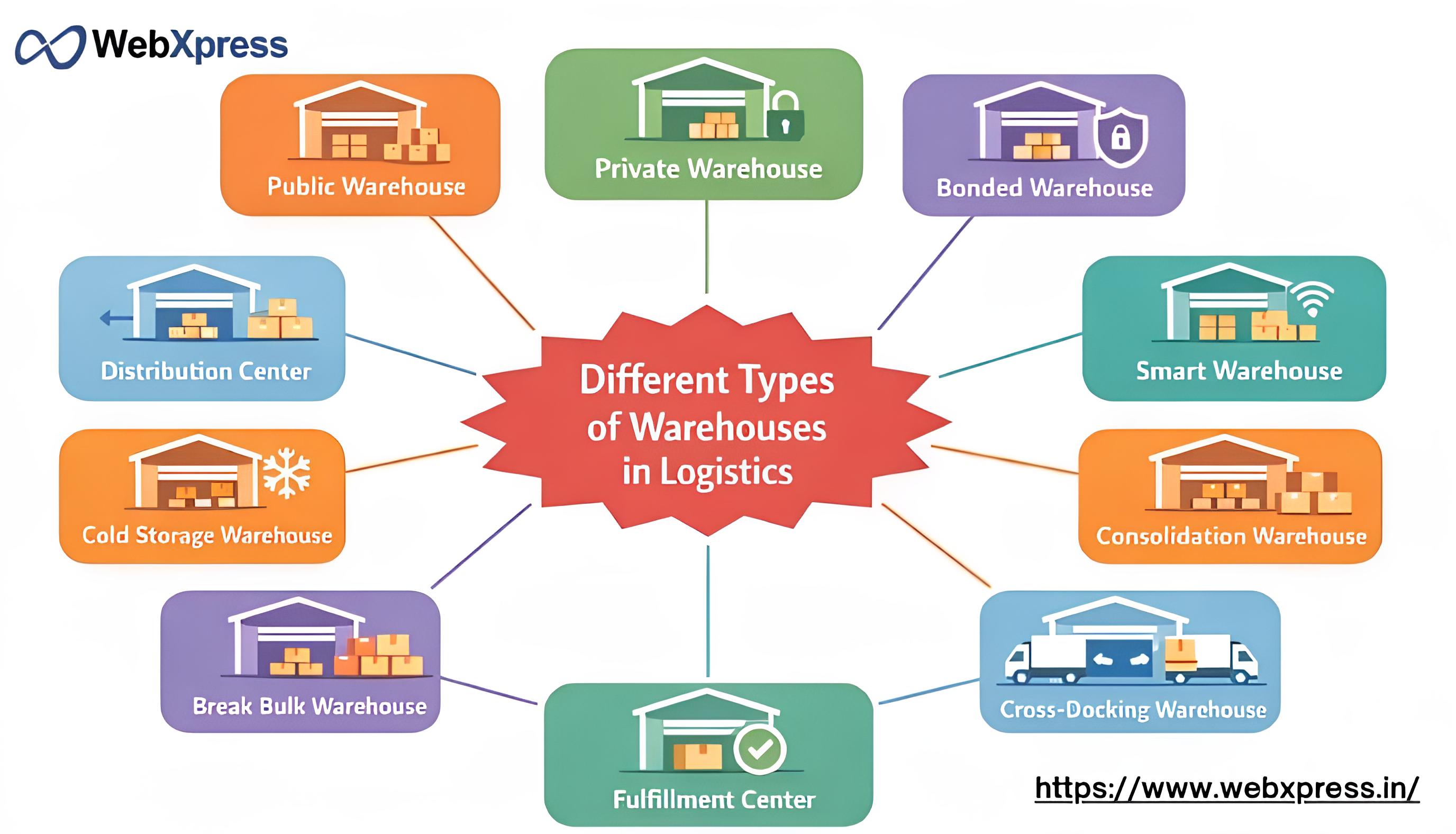
There are many types of warehouses used in logistics. Each type has a specific purpose. Businesses choose a warehouse based on product type, storage needs, and delivery model. Below are the different types of warehouse explained in detail.
A public warehouse is owned by a third-party company that provides storage space to multiple businesses. Companies can rent space based on their storage needs. It can be for a short period or a long-term contract.
This type is suitable for small and medium businesses that do not want to invest in land, building, or equipment. The warehouse provider manages security, staff, and daily operations. Businesses only pay for the space and services they use.
Public warehouses are also helpful during seasonal demand. A company can increase space during peak season and reduce it when demand drops.
Key Benefits of Public Warehouse:
A private warehouse is owned and managed by one company for its own storage needs. Large manufacturers, wholesalers, and retailers prefer this option because they deal with high inventory volumes.
The company has full control over warehouse layout, staff, and systems. Storage racks, safety standards, and workflow can be designed as per business needs. It supports long-term business growth.
This type requires high investment in construction, equipment, and manpower. Ongoing maintenance and operating costs are also handled by the company.
Key Benefits of Private Warehouse:
A bonded warehouse is used to store imported goods before customs duties are paid. Goods remain under government supervision until clearance is completed.
Importers can store products safely and delay tax payments until goods are sold or moved out. It improves financial planning for businesses involved in international trade. Bonded warehouses are commonly used for electronics, liquor, luxury goods, and imported machinery.
Key Benefits of Bonded Warehouse:
A distribution center focuses on fast movement of goods. Products are received from manufacturers and quickly sorted for delivery to retailers or customers.
Storage time is usually short. The main goal is speed and accuracy in order processing. Retail chains and eCommerce companies rely on distribution centers to maintain steady supply. Technology and warehouse software systems are often used to track stock and manage shipments.
Key Benefits of Distribution Center:
A cold storage warehouse keeps temperature-sensitive products safe. It maintains a fixed temperature range depending on product type.
Food items, dairy products, frozen goods, vaccines, and medicines are commonly stored here. Proper temperature control prevents spoilage and damage. It requires special insulation, cooling systems, and monitoring equipment.
Key Benefits of Cold Storage Warehouse:
A smart warehouse uses automation and digital tools to manage operations. Barcode scanners, RFID systems, robotics, and software are commonly used.
Advanced warehouse management systems help track stock in real time. Inventory updates happen instantly, which reduces errors. Manual work is reduced and productivity improves. It supports faster picking, packing, and shipping.
Key Benefits of Smart Warehouse:
A consolidation warehouse collects small shipments from different suppliers. These small loads are combined into one large shipment.
It helps reduce transportation cost and improves truck space usage. This type is commonly used in export operations and bulk transport planning. It is useful when goods are coming from multiple locations to one final destination.
Key Benefits of Consolidation Warehouse:
A break bulk warehouse works in reverse order. Large shipments arrive and are divided into smaller lots. These smaller loads are delivered to different retail outlets or customers. It supports regional distribution networks. Wholesale businesses and distributors use this type to supply goods to multiple stores.
Key Benefits of Break Bulk Warehouse:
A fulfillment center is mainly used for online businesses. It stores products and processes customer orders.
Once an order is received, items are picked, packed, and shipped directly to the customer. Fast delivery is the main focus. Inventory is tracked using warehouse software systems. It helps reduce delays and manage returns smoothly.
Key Benefits of Fulfillment Center:
A cross-docking warehouse reduces the need for long storage. Goods move directly from incoming trucks to outgoing trucks.
Products are sorted quickly and sent for delivery. Storage time is very short, sometimes only a few hours. This method reduces storage cost and speeds up transportation.
Key Benefits of Cross-Docking Warehouse:
Choosing the right warehouse depends on your business model, product type, and delivery expectations. Not every warehouse suits every business. A wrong choice can increase cost and slow down operations.
First, understand your storage needs. Check how much inventory you handle daily or monthly. A small business with limited stock may prefer a public warehouse. A large company with steady demand may benefit from a private warehouse.
Product type also matters. Perishable goods need cold storage. Imported goods may require a bonded warehouse. Fast-moving products may work better with cross-docking or a distribution center.
Budget plays an important role. Private warehouses need high investment. Public warehouses reduce upfront cost. Smart warehouses require technology spending but improve long-term efficiency.
Location is another key factor. A warehouse closer to customers reduces transportation time and cost. Good road connectivity and access to transport hubs also improve logistics performance.
Technology support should also be considered. Many businesses now depend on different types of warehouse management systems to track inventory, manage orders, and reduce manual mistakes. A warehouse with proper system support improves accuracy and visibility.
Warehouse operations need proper system support to run smoothly. Manual work often causes stock errors, delays, and poor coordination between teams. WebXpress helps businesses manage different types of warehouses in logistics with better control and visibility. It brings inventory, orders, and warehouse activities into one system.
Inventory tracking becomes simple with real-time updates. Businesses can check stock levels anytime and avoid overstocking or shortages. Order processing also becomes faster because picking, packing, and dispatch activities are properly managed. This reduces mistakes and improves delivery timelines.
WebXpress also connects warehouse operations with transportation planning. Better coordination between warehouse and transport improves overall supply chain flow. Detailed reports help managers understand performance and make better decisions. With advanced types of warehouse management systems, businesses can increase productivity and reduce operational costs.
A fulfillment center or distribution center is suitable for eCommerce businesses. These warehouses focus on fast order processing and direct customer delivery.
Different types of warehouse management systems help track inventory, manage orders, and reduce errors. They improve accuracy and increase warehouse efficiency.
Businesses consider product type, storage needs, budget, location, and future growth plans before selecting the right warehouse type
A cold storage warehouse is suitable for perishable goods like food, dairy products, and medicines. It maintains controlled temperature to keep products safe and fresh.
A distribution center focuses on fast movement of goods. It receives products, sorts them, and quickly ships them to retailers or customers. It helps maintain steady supply and faster delivery.
A smart warehouse uses automation and different types of warehouse management systems to track inventory in real time. It reduces manual errors, speeds up order processing, and improves overall productivity.
Warehouses play a major role in supply chain and logistics operations. Different types of warehouse support different business needs. Some focus on long-term storage, while others focus on fast movement of goods.
Understanding the types of warehouse in logistics helps businesses select the right option based on product type, budget, and delivery expectations. A proper warehouse setup improves inventory control, reduces delays, and supports smooth distribution.
Technology also plays an important role today. The right warehouse combined with proper system support helps businesses grow efficiently while maintaining strong operational control.
Copyright 2026, WebXpress. All Right Reserved
Design & Developed By